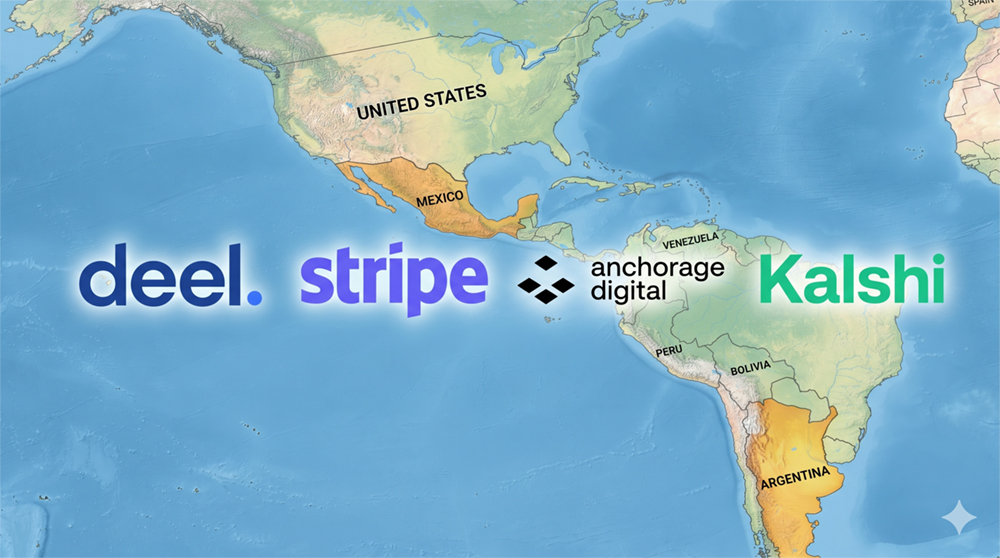
The Commodity Futures Trading Commission has officially approved Kalshi to
launch the first onshore, regulated Bitcoin perpetual futures in the United States.
Deel has partnered with Stripe and allows workers in Argentina to receive their
earnings in DLUSD. Meanwhile in Europe, Piraeus Bank joined the 37-institution Qivalis banking
consortium to assist in developing a fully regulated, euro-pegged stablecoin.
Expanding international corporate utility, Anchorage Digital partnered with Mexico’s
Grupo Salinas to modernize cross-border settlements using federally issued
stablecoins on blockchain rails. Concurrently, the European Central Bank published a formal assessment detailing
the structural risks that these expanding private stablecoins could pose to monetary sovereignty.
Kalshi prediction markets exchange ,Secures CFTC Approval to Launch First
Onshore Regulated Bitcoin Perpetual Futures
The U.S. Commodity Futures Trading Commission (CFTC) officially approved
KalshiEX’s BTCPERP contract, introducing the first U.S.-regulated bitcoin perpetual
futures contract listed on a domestic exchange.
While offshore perpetual futures contract volume grew from $28 trillion in 2023 to
over $90 trillion in 2025, this milestone transitions a portion of the market to an
onshore, regulated framework.
Kalshi’s contracts will trade directly on its CFTC-regulated platform, whereas
Coinbase is entering the market simultaneously by routing its perpetual contracts
through a Bermuda-based subsidiary. This launch marks a structural pivot for Kalshi,
which previously focused on binary event contracts and recently achieved a $22
billion valuation after a $1 billion Series F funding round in May 2026.
Anchorage Digital and Grupo Salinas Partner to Utilize Stablecoins for Cross-
Border Settlement
U.S. digital asset bank Anchorage Digital and Mexican conglomerate Grupo Salinas
have formed a strategic alliance to integrate blockchain payment rails into
international corporate transaction flows.
The framework leverages Anchorage Digital’s “Stablecoin Solutions for Banks”
product to execute cross-border settlements between the United States and Mexico.
This infrastructure relies entirely on federally issued stablecoins as the underlying
settlement mechanism, bypassing legacy correspondent banking networks and
SWIFT processing delays.
Grupo Salinas will process these payments through its Coinpro entity to reduce
transaction settlement cycles for Grupo Elektra, its retail and financial arm.
Anchorage Digital stated that the underlying digital dollar infrastructure remains open
to additional participating financial institutions.
Deel Integrates Stripe Infrastructure for Contractor Stablecoin Wallet
Deel has partnered with Stripe to launch a stablecoin wallet enabling millions of
international contractors to hold, earn, and spend a US dollar-backed balance.
Powered by Stripe’s infrastructure, the system allows workers to receive their
earnings in DLUSD, a custom USD-denominated stablecoin issued through Bridge’s
Open Issuance.
These digital funds land in an embedded Privy wallet on the platform, where
transactions are processed on Tempo for near-instant settlement.
The feature is available today to contractors in Argentina—where local currency
fluctuations are severe—
“with rollouts to remaining LATAM countries coming in the
next few weeks, and APAC, MENA, and Africa to follow.” Stripe reported.
Furthermore, users are eligible to earn rewards on their digital holdings and can
spend their balances globally using the Deel Card.
Piraeus Bank Joins 37-Institution Qivalis Banking Consortium for Euro
Stablecoin Development
Piraeus Bank leading financial institution in Greece has officially joined the Qivalis
banking consortium, expanding the group to 37 financial institutions across 15
European countries.
The consortium is designing an on-chain native settlement infrastructure
denominated in euro to support real-time liquidity movement for corporate treasuries,
smart-contract programmable payments, and atomic settlement for tokenized assets
like bonds and real estate.
The proposed digital token will be fully backed on a 1:1 basis with fiat euro reserves.
To establish a compliant framework under MiCAR, Qivalis is currently pursuing
Electronic Money Institution (EMI) authorization from the Dutch Central Bank (DNB).
The formal launch of the euro-denominated stablecoin is scheduled for the second
half of 2026.
European Central Bank Assesses Structural Risks of Private Stablecoins to
Monetary Sovereignty
In a formal address on June 1, 2026, European Central Bank Executive Board
Member Isabel Schnabel outlined the macroeconomic challenges private stablecoins
present to central banking authorities.
The ECB stated that the global expansion of fiat-pegged digital tokens introduces
specific risks to financial stability, monetary policy transmission, and the international
financial order.
Current metrics indicate that around 85% of overall transaction volume on crypto
trading platforms involves stablecoin pairs, while alternative commercial use cases
currently maintain a smaller market share.
The analysis concluded that central banks must actively modernize payment
systems to safeguard the anchoring role of sovereign fiat currency.
The future trajectory and adoption rates of non-crypto trading
stablecoin use cases remain subject to high uncertainty.